
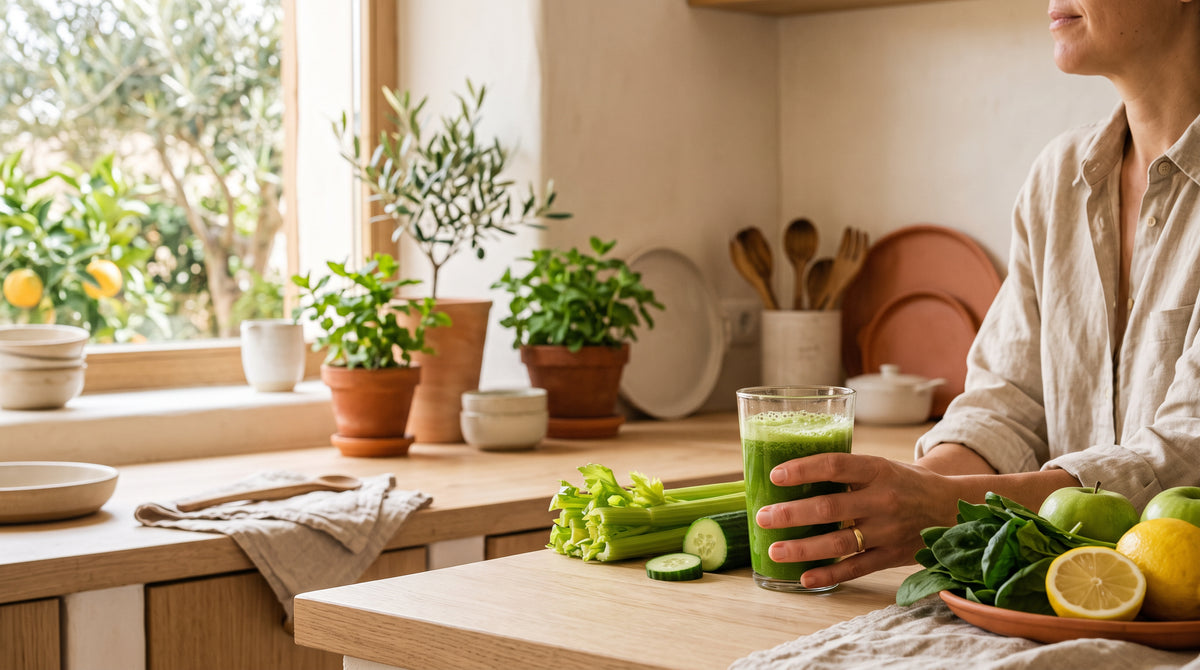
When someone starts paying attention to their food, they almost always think about what to take away. But there's a simple move that goes in the other direction: adding more vegetables to your day. And one of the easiest, most enjoyable ways to do that is a good vegetable juice.
It isn't a fad or a miracle promise. It's simply a practical way to bring more of the vegetables that are often missing onto your table, and to do it with flavour, without complicating your life.
Why vegetables have such a clear place in the 3x1® Diet
In the NaturalSlim® System we teach people to eat according to the 3x1® Diet: there are no forbidden foods, just a proportion. Three quarters of the plate are Type A Foods (the ones that help you slim down) and one quarter are Type E, the ones that add weight.
Vegetables are the heart of Type A Foods. They fill the plate, add variety, and make eating well easy to keep up over time. A vegetable juice is, at heart, just another way to give your body more of what you already know suits it.
Think of it this way: your body is an engine that works every day. Vegetables are part of the good-quality fuel that keeps it running. It's not a trick. It's giving it good raw material, consistently.
A simple idea to get started

You don't need anything fancy to make your first vegetable juice. The key is to vary the ingredients so you don't get bored, and to find a taste you'll want to repeat.
- Green base: spinach, lettuce or cucumber. Mild and easy to combine.
- For body: carrot, broccoli or celery.
- A fresh touch: a squeeze of lemon.
- If you want it a little sweeter: half a green apple. Remember fruit counts as Type E, so a small amount is plenty.
Frank Suárez himself recommended changing up the vegetables and making sure the juice tasted good, not just "healthy". His logic was simple: what you enjoy, you keep. And what you keep up over time is what really makes the difference.
What they actually contribute, without overstating it
Vegetables are a good natural source of minerals like magnesium and potassium. It's worth being honest about what that means, without spectacular promises. Here is what these minerals contribute to:
- Magnesium contributes to normal functioning of the nervous system, to normal muscle function, to normal energy-yielding metabolism, and to a reduction of tiredness and fatigue.
- Potassium contributes to normal functioning of the nervous system and to normal muscle function.
No "miracle cleanses" and no big headlines: the value of vegetables lies precisely in those solid, everyday functions that keep a well-working body going, day after day.
Juice as a complement, not a replacement
A vegetable juice is a good habit, but it doesn't replace a balanced way of eating. Juicing leaves behind part of the fibre of the whole vegetable, so it's best seen as an addition to your day, not the foundation of everything. The usual rules apply: variety, balance and consistency.
If, within your routine, you're also interested in getting minerals in a form that's easy to take each day, NaturalSlim has two options many people use as part of their daily routine: MagicMag®, a magnesium citrate powder you mix with water, and Kadsorb™, which provides potassium. They don't replace vegetables. They go alongside them.
Start where it's easy
You don't have to change everything at once. Add one vegetable juice to your week, keep the 3x1® Diet proportion on your plate, and notice how you feel. The body is alive: it learns and adapts when you give it what it needs, with patience.
And if you'd like to organise your eating within a wider approach to your metabolism, you don't have to do it alone. At NaturalSlim Europe you have a team of Certified Metabolism Consultants™ here to guide you according to your situation. You can explore the NaturalSlim Personal Program to see how it all fits together. There's nothing to buy to get started: the first step is simply talking to someone who understands your metabolism.


Share:
What Type of Magnesium Should You Take? Citrate vs Oxide
What digestive enzymes are (and what Helpzymes is)